Saturday, 3 August 2013

The Many Themes of Disney: An Overanalysis


For over 75 years, Disney has been synonymous with good animation.  And for good reason.  Most people watched a Disney film so far into their childhood they don't even remember it; all they remember is that it was good.  Then as they grow older they start to notice all the political incorrectness, and over-extend metaphors for drugs, and devise drinking games with their college buddies.  Then they grow older still and become parents, realising how effective the morals are and deciding their children could learn a thing or two, and so the circle of life continues.

That being said, everyone has differing views on different films- for instance my personal favourite is Hunchback of Notre Dame despite it receiving comparatively low ratings.  I have given this some thought, and separated groups of films into several recurring themes- if my theory is correct then the most popular films should contain several of these themes, whilst the least popular may only contain one or two.  More may follow in a future update.

The Princesses.
Newest at the front, ethnics at the back.
The theme Disney wants you to believe in.  Children want to be the princesses, young adults want to criticise the 'forgotten' princesses, and adults want good role models for their children (something only recently being addressed by Disney).  For the purposes of this article, I will divide the princesses accordingly.
The 'popular' princess films: Snow White, Cinderella, Sleeping Beauty, The Little Mermaid, Beauty and the Beast, Aladdin, Tangled, and Princess and the Frog.
 Odds are children will want to imitate the heroine from at least one of these films, and if they do then the theory is that they will enjoy the others in this group.  Note that they have been getting progressively 'stronger' as society has progressed to have better female role models.
The latest 'Disney Princess'
The 'other' princess films: Pocahontas, Mulan, Brave, The Black Cauldron, Wreck-it-Ralph, and Princess and the Frog.  These are the princesses that some claim Disney have 'pushed aside' due to being unmarketable, whether due to ethnicity or age.  Note the inclusion of Princess and the Frog, as some consider the film to be too recent for Tiana to be forgotten, but her time is coming due to her ethnicity.  These films are most enjoyed by those that enjoy pointing out Disney's political incorrectness.  Incidentally these are also the strongest female role models.
The 'hipster' princess films: Bambi, Peter Pan, Robin Hood, Hercules, Atlantis, and Enchanted.  This category is so named as it is most enjoyed by those that have a smug self-satisfaction when explaining to others how the female leads are 'technically' Disney princesses whilst not being officially considered as such.  These viewers are most likely to call Princess Leia their favourite princess, as she's 'technically' a Disney princess now.

Snakes.
Prominent examples: Aladdin, Robin Hood, Sword and the Stone, Princess and the Frog (special mention to the Little Mermaid, which used snake-like fish).
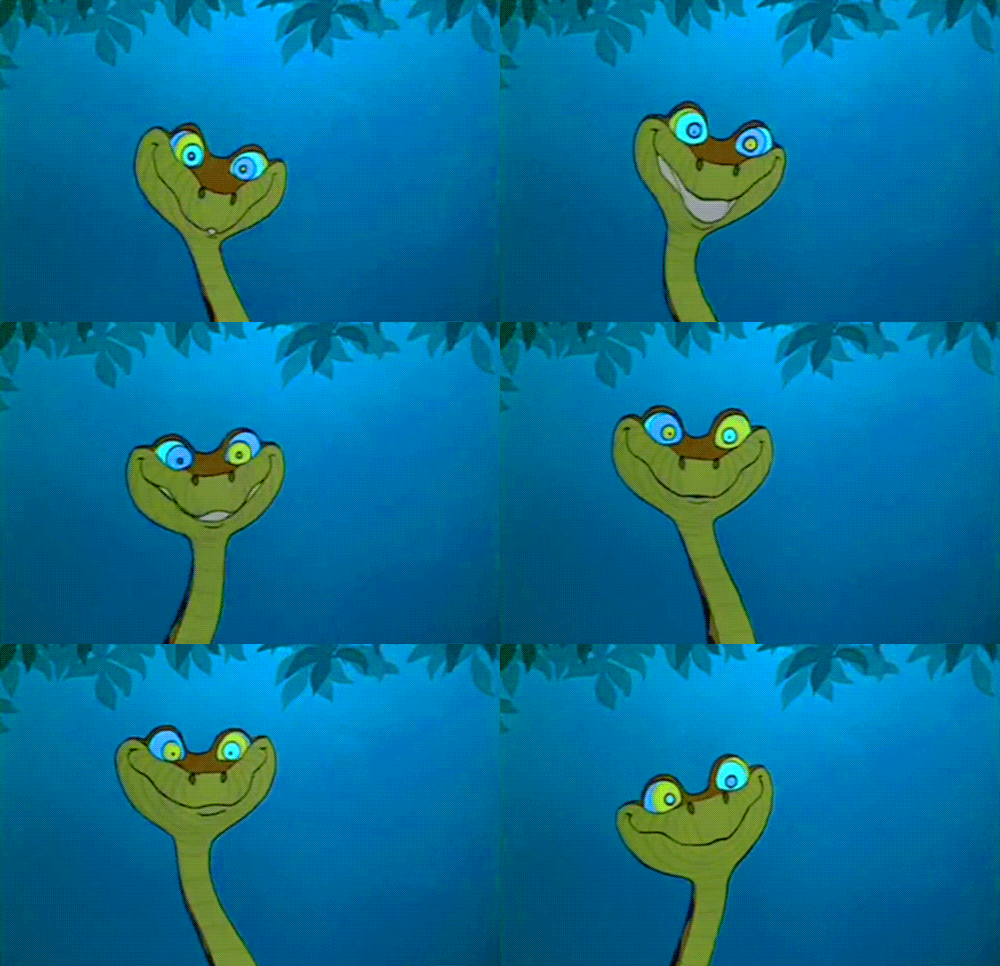
Just ignore the fact he sounds like Winnie the Pooh.
Snake imagery is used a lot in Disney, occasionally in a hypnotic form (see: Kaa, and Jafar's staff).  Interestingly they are always shown as cowardly- a somewhat unusual characterisation that I don't believe I have seen outside of Disney.  More typically, they are also shown as highly untrustworthy.  They are always a supporting villain (except in Princess and the Frog, which subverted many clichés), to the extent that the majority of appearances happen in the various tv spin-offs.  If you enjoy this Disney-specific archetype, your favourite film is likely to be the Jungle Book.

Cats.
Most commonly occurring in contemporary films, cats are often inherently evil or at the very least mischievous- rarely are they shown in a positive light.
Never trust a grinning cat.
'Evil' cats: Sword and the Stone, Cinderella, Basil the Great Mouse Detective, Emperors New Groove, Pinocchio.  The cats are most commonly manipulative, greedy, or outright evil.  Not unique to Disney, as many consider real-life cats to be inherently evil and vindictive.  If you enjoy evil cats, your favourite film is probably Lady and the Tramp- two evil cats for the price of one, and as you're probably a dog person you get the bonus of the protagonists being dogs.
'Big' cats: Jungle Book, Tarzan, Aladdin.  Interestingly, big cats are wise and friendly- with the exception of Sabor from Tarzan who is a mindless killer.  Naturally, if you enjoy films with big cats then your favourite film is the Lion King.
'Mischievous' cats: Aristocats, Pinocchio, Oliver and Company.  Often these cats are kittens that are yet to learn they're supposed to be evil, however your favourite is probably going to be the Cheshire cat from Alice in Wonderland.

Alcohol/ Drug references.
Almost every film involves alcohol or other drugs- seriously, keep an eye out next time you watch one.  It may be for brief moments, such as glasses of wine in Aladdin, or the feast of fools in Hunchback, but at other times it's more noticeable- join me as I play 'Drink along with Disney'.
Robin Hood- Sir Hiss gets drunk after being trapped in a barrel of (strangely coloured) ale.
Beauty and the Beast- Copious amounts of drinking with Gaston in the tavern.
Basil The Great Mouse Detective- A drunk mouse finds himself in trouble
Pinocchio- Alcohol and tobacco contribute to Pinocchio 'making an ass of himself'.
Nightmare fuel.
And, of course, the pinnacle is Dumbo- full on Disney Acid Sequence from Dumbo indulging in too much champagne.  This crosses over into the next subcategory: the Disney Acid Sequence, things that must have been conceived whilst under the influence.
The Lion King- 'I Just Can't Wait to be King'.
Winnie the Pooh- Various.
Aladdin- 'Friend Like Me'.
If you like any of the above over any other Disney feature, then odds are your favourite film is either Alice in Wonderland or Fantasia- both are feature-length acid trips, Fantasia getting the edge as it even involves Dionysus the God of Wine.

Fire.
Fire is the one element that appears in every Disney film, and seems more prominent in the more popular films.  This is probably the theme that attracts me most, and through sheer coincidence the more fire there is, the more I like it.  Here's a run-down of my top 10 Disney films, and the amount of fire involved. (Special mention to Toy Story 3 for the furnace, as I wasn't going to include Pixar).
Hercules- Hades' 'angry' face.
Dumbo- The circus act.
Sword and the Stone- the Wizard's Duel.
Fantasia- A glimpse of the pits of Hell as shown in Night on Bald Mountain.
Robin Hood- Prince John's castle is set alight.
Aladdin- Climactic battle in a ring of fire.
The Lion King- Lightning sets fire to the desolated pride lands.
Jungle Book- Lightning sets the scene for a climactic battle in a ring of fire.
Hunchback of Notre Dame- the whole city of Paris is set alight, and there's a song dedicated to Hellfire.
Treasure Planet- an entire planet goes up in flames.

OK, I take back what I said at the start- Treasure Planet is my favourite Disney film.

Tuesday, 23 July 2013

Monthly Update: 7/13

Greetings!

Unfortunately 'Full steam ahead' is proving slightly more difficult than anticipated, mostly due to the lack of landlords that accept Housing Benefit.  The plan was initially to get a small flat in the Bristol area, where I could then find a job to raise some money ready to move to a slightly bigger/ more convenient flat and save up a bit for the shop; but to do all that Housing Benefit is required just to cover the time spent looking for work.  I thought it would make more sense for landlords to accept Housing Benefit as in a lot of cases it's more reliable than having a job, but apparently there's so much red tape involved and constant changes to the law that it's not worth the landlord's while, especially in a high-demand area like Bristol.  Which is fine.

Now the plan is to find a job first that's willing to wait for me to move closer, which is considerably more difficult, what with the amount of competition that most likely live closer already.  But I will continue on.

The third alternative is I win the lottery and move straight to Bristol and open the shop next month- you never know, it could happen!

Thank you for being patient, and I hope you will stick with us on this journey- once again, any feedback is greatly appreciated.  Currently we are considering the feasibility of running a café element to the shop, so any ideas regarding that will be most welcome.

Until next time,

Rooksburg.

Rooksburg Reviews: The Long Game

Doctor Who s1e07: The Long Game

The Doctor and Rose, with their new companion Adam Mitchell, find themselves on Satellite 5- a space station dedicated to transmitting news to the Fourth Great and Bountiful Human Empire.  As usual, all is not what it seems as people who are 'promoted' to floor 500 are never seen again, technology is outdated, and something's wrong with the plumbing...

An interesting story with interesting characters, some good character development, an important milestone, and yet I still forgot this episode even existed.  As they say, there's nothing worse than a 3-star review, as you're not mind-blowing, nor are you 'so bad it's good'; merely mediocre, bland and forgettable.

The main point of this episode centres around Adam (again, a completely forgettable companion).  Adam
Who?
was in the museum from last episode where he was somewhat likeable compared to the Americans, so Rose immediately took a fancy to him (showing no remorse over Mickey) and convinced the Doctor to let him tag along.  On arriving at the space station he immediately faints from culture shock before showing his true colours by smiling deviously after being given the magic phone and the TARDIS key; clearly the Americans rubbed off on him.  Despite being so forgettable, he is notable for one key point- he is the first and so far only companion to get kicked out of the TARDIS for bad behaviour, an impressive feat though to me it felt slightly harsh; Rose was supposed be on a date with Adam but ran off with the Doctor, both abandoned Adam in a strange uncomfortable place, and Adam did want to change the world for the better (albeit with personal gain in mind, but the Doctor has been guilty of that himself before).  Ultimately it just felt like the Doctor wanted an excuse to get himself and Rose alone together again.

The editor, with the 'editor-in-chief'
The 'monster of the week' is the Mighty Jagrafess (of the Holy Hadrojassic Maxarodenfoe), who is an amorphous indecipherable creature attached to the ceiling in floor 500 and ultimately doesn't do much- arguably the true villain is Simon Pegg's character, 'The Editor', as he is the one operating the station whilst the Jagrafess oversees.  They have been controlling the media for 90 years in attempt to enslave the human race without them even realising, and it would have worked if the Doctor hadn't come along.  Again, they are fairly decent villains- neither are doing anything particularly evil (aside from killing anyone who knows too much), and the point is raised 'is it really slavery if the slaves don't know about it', though this is immediately shot down by the Doctor who isn't in the mood for philosophical debate.  Also interesting is the fact that the Doctor doesn't save the day this time, instead enlightening an ordinary girl who takes matters into her own hands.

Not much more to say on this one.  Everything is 'good, not great' which leads to a fun 45 minutes but not a memorable one, and in a way slightly disappointing when this series often strays into 'so bad it's good' with its camp cheesiness.
First Impressions: Pleasantly surprised, might give some credibility to the series.
In Retrospect: Oh yeah, this episode... Simon Pegg's cool.

Next Time: Father's Day.  (aka the reason why I haven't dwelled on Rose's selfishness this episode)

Saturday, 6 July 2013

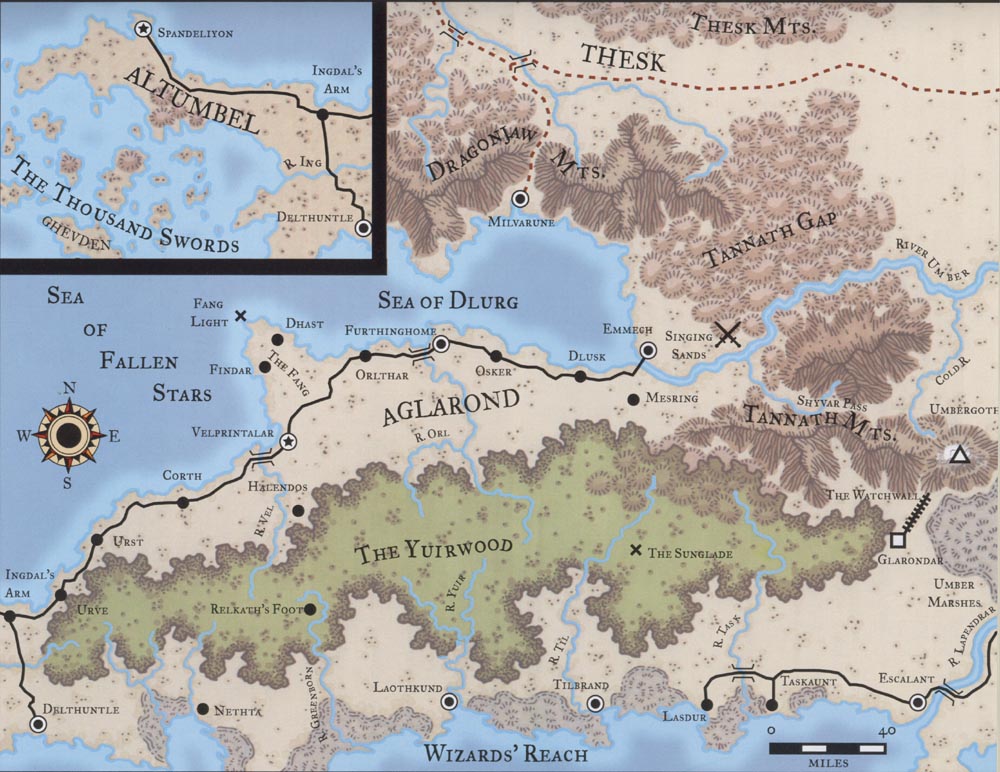
The Traveller's Guide to Faerun: Furthinghome, Aglarond

Aglarond
Climate: Warm Temperate.
Terrain: Dense Forest, Rocky Coast, Hilly Farmland.
Population: Mostly Human, Some Half-Elf.

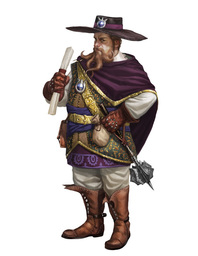
I arranged transport with a passing merchant as soon as possible, packing the bare minimum- some field rations, some coin, and a rapier.  Most of my new friends turned up to see me off, though Lynne was absent; one of her friends told me that she was upset, thinking I would be 'different' from other men which frankly shouldn't be a surprise as I'm not human.  The friend looked at me with an expression of horror when I told her this, then walked off shaking her head.  Truly there was much for me to learn about humans, and with this thought in mind I headed off to the nearest city.

On the road I attempted to curb my enthusiasm, though there were so many extraordinary sights.  When the
My first companion!
clouds had cleared the rolling hills were a beautiful green bathed in the golden light of the sun.  To be honest I am surprised the merchant put up with my incessant questions!  He was a likeable man; a human.  One of the first lessons I would learn is that one should always state a person's race in Faerun, as there are so many varied species and everyone seems to bear some resentment against the others.  The merchant told me his name was John, and that he was born in the town to which we were headed- Furthinghome, on the Aglarond coast.  He then gave me some tattered robes with a cowl that would cover my face, saying that the humans of the city were distrustful of other races, especially ones that looked like they might be elven.  He also told me that despite my desire to explore, I should stick with him as we wouldn't be staying long.  He just had to make an exchange then we would be on the road to Velprintalar; home to a powerful mage who should be able to tell me how to get home.  Finally John had a warning- if we did somehow get separated then I should avoid Thay at all costs.  It was a land beyond the mountains behind us, and he warned that if I ever encounter a wizard dressed in red then I should avoid them, as I would most likely be kidnapped and experimented on in a tower somewhere.  I found this hard to comprehend- humans seemed to have such varied personalities.  The majority I had met so far were friendly, but then there was Lynne's unusual behaviour, and now the stories of these horrible wizards!

As we approached Furthinghome I heard a somewhat familiar sound, and sure enough there were tens of peacocks roaming the countryside!  I had seen peacocks before in Djinni zoological collections, but I was unaware they were wild here.  Sadly John had to point out to me that they were not in fact wild, but had escaped from a local dilapidated estate.  I made a mental note to explore this estate, but I was soon distracted as I caught a salty smell on the wind, and as we passed one last hill I was met with yet another
Such beautiful greys!
spectacular sight- the sea!  Like a combination of land an air, it had the same sort of blue as the sky but looked more... solid.  Yet at the same time, not as solid as the land due to its constant movement.  Of course, now I look back and laugh at my naivety, but back then it was simply too much for me- I almost fainted from the experience, but instead I entered a trance-like state, fascinated with my surroundings and paying no heed to the man asking me questions- one of the city guard.  Luckily John covered for me, telling the guard I was a relative and had been 'touched in the head'.  Thankfully I felt a little more comfortable inside the city, as it was reminiscent of the Djinni cities back home, though the architecture was much less grand, consisting mostly of weathered wood and stone that hadn't taken kindly to the salty sea air.  We followed the main road into the centre of the city, John pulling me along as I was getting distracted by the sounds of seagulls and smells of the countless spices being sold at the stalls that lined the street.
'Here we are, Old Furthing,' said John, 'I have business to attend to, so I shall meet you back here at Highsun in two days time.  I've already booked us lodging at the Beached Mermaid by the docks.  Now I'm already late, so see you soon!'
I turned to tell John I had no idea where 'here' was, or even what 'highsun' is, but he had already gone.  I was alone in this city.
Furthinghome
Type: Large City, Small Trading Port
Population: Mostly Human, Few Half-Elf
Reputation: Wealthy, though slums harbour anti-elf extremists
Imports: Exotic Goods
Exports: Fish, Timber, Herbs and Spices

I remained calm, and decided that I may as well have another look at the sea whilst I had the chance.  Presumably that was where the docks were as well, as my only previous experience of docks involved airships.  Before I knew it I had spent the rest of the day just sitting on the docks, watching the sea and the sunset.  The next thing I learned was that humans have very poor night vision- as I looked for the Beached Mermaid several careless humans bumped into me before running off.  Eventually I found the inn and told the landlord I was with John the merchant.  He said he had been expecting me, though there had been no sign of John yet, and I was shown to my room.  It was possibly the earliest night I'd ever had, and it pained me to be missing out on the drunken revelry below my room, but after the days I'd had I was in need of well-deserved rest.

Morning came, and the first thing I noticed was that my door was open- I must have forgotten to lock it in my overtired state.  I headed down to the bar, but other than a few unconscious men littering the bar it was empty, so I set off to find some food.  It was early in the morning, but the city was still bustling with activity as market stalls were already peddling their wares- mostly exotic items, and things made to look exotic.  It was at this point I realised I had no money to buy food with, despite being sure I had some the day before.  This didn't bother me too much, after all that's what field rations are for- though I would have to find some money somewhere, which meant finding work.

Friday, 5 July 2013

Rooksburg Reviews: Dalek

Doctor Who s1e06: Dalek

In a subterranean museum in Utah lies a vast collection of alien artifacts- the pride of which is sending a distress call that the Doctor receives.  What is this prized artifact?  Well the title of the episode may give a clue, it's a Dalek- the Doctor's most hated enemy.
Spoilers!
Straight away we see the main flaw in this episode; the fact that it tries to build suspense despite the title already giving the big reveal.  Aside from this relatively minor flaw (it's not even noticeable so long as you avoid the 'next time' trailer and aren't paying attention to the title when it comes on screen), this is a pretty decent episode, though I would say it would be better suited later on with slight script changes.  The purpose of the new series was to introduce Doctor Who to a new audience, and as such it should be assumed that some of this audience may not have heard of the Daleks.  If their first experience is this episode, I would be quite disappointed.  It shows that Daleks are nigh-unstoppable ruthless killing machines, but that they also have a sensitive side (albeit caused by some 'biomass extrapolation', but still).  I'm also not happy with 'levitate' and found it a bit cheap, but I suppose they needed to address the problem of stairs at some point.

The theme of this story is to hold a mirror to the Doctor.  Previously we have seen him take a relaxed view to what goes on around him, only getting involved if he absolutely has to- but this time he's involved due to personal hate and fear, not entirely unlike a Dalek's motivations.  Due to this, this episode is quite an important one for the series as it shows the first time the Doctor's really been torn up by his actions in the Time War, which some have speculated we haven't seen the full ramifications of until this year's 50th anniversary special.

Regarding the supporting characters... oh dear.  Poor Americans, they just can't catch a break from us Brits-
The trolls have taken over the internet.
we have a view of Americans that depicts them as loud, greedy, ignorant, gun-toting, cowardly people that have a condescending view of the British; and this episode reinforces every single one of those stereotypes without any redeeming features.  We have the museum's owner, and owner of the internet, Henry van Statten who displays a tenacious single-mindedness to ensuring the Dalek doesn't get damaged, even when it's killing his entire staff- until the point where his own life is in danger at which point he'll stop at nothing to save his own skin.  We also have Diana Goddard, who is van Statten's right-hand woman (after his former assistant disagreed with his ambition to become president) and immediately betrays him to take his place when all is safe.  Another significant member of van Statten's staff, Simmons, takes delight in torturing the Dalek, even taunting it when it's fully operational.  The final American is a guard who disregards the Doctor's advice in dealing with the Dalek (concentrate on the eye-stalk) and goes for a brute force approach only to be killed within seconds.  To highlight how loathsome these Americans are, we have an Englishman working with them- Adam Mitchell- who is constantly belittled and mocked, and demonstrated to be a generally much nicer person than the Americans.  He also serves to show how heartless Rose is, as within seconds of meeting him, she starts flirting with him; again, completely forgetting about Mickey.  A vague attempt is made to show Rose's compassionate side, but it doesn't really work when she's being sympathetic towards the most feared being in the whole universe.

First Impression:  Pretty good, but aren't Daleks meant to be terrifying?  Yet a single human can cause them to question their own existence?  Sounds a bit lame...
In Retrospect:  Still pretty good, wish we'd seen a Dalek story before this though just so we'd know how terrifying these creatures are supposed to be.  Unfortunately, this won't be the only time RTD attempts to make the Daleks 'sympathetic' villains...

Also, this episode features a topless Christopher Ecclestone, which I'm sure is good enough reason for some of the female fans to watch it (and probably some male fans too).

Next Time:  The Long Game.

Friday, 28 June 2013

Devil's Advocate: Video Games

With all the talk going round at the moment about the XBox One and the various 'blunders' it's made, I thought I would attempt to find some method in the madness.  After all, Microsoft, Sony and Nintendo wouldn't be some of the most valuable companies in the world if they didn't have any business sense.

Before I start, I would like to make it clear that I don't necessarily believe any of the points raised below are 'right'- I'm just trying to see the logic behind them.

'Always Online' DRM
The facts: Several games require the device they are being played on to be constantly connected to the internet, otherwise the game is unplayable.  This is usually as anti-piracy measure (as they can check whether you have a legit copy of the game or not if you're connected to their server), but is increasingly being used to boost performance due to cloud computing.
The problem: Although the state of things is rapidly improving, there is still a huge issue with connectivity.  Rural areas are sometimes barely better than dial-up, and for some gamers the internet isn't an option (especially relevant to those in armed forces).  This wouldn't be much of an issue, were it not for the fact that even single player games now require internet connections.  Then comes the issue of if the servers are hacked, meaning even those with good connections can't play...
The company's opinion: Microsoft is the biggest disaster here, as a representative stated that dropping connectivity isn't an issue at all in the modern world, and if you have a problem with it you can just keep playing your XBox 360 and probably couldn't afford a new console anyway.  The more tactile approach would have been to explain that Microsoft has plans to utilise cloud computing to boost the performance of their already-impressive console, and therefore their online policy would be a necessary evil.  Besides that, their online policy didn't require always-online, instead connecting just once every 24 hours- a much more reasonable requirement that was sadly overlooked.
The result: No company has successfully demonstrated the pro's to an online connection for a single player
Yeah, that blunder.
game.  Sim City came close, but due to the huge blunder that was their launch it has dropped off the radar.  Regarding Microsoft, they have u-turned on their policy, again without stating the benefits of cloud computing, instead merely saying the decision to be online or not is down to the consumer.  The message this sends is that Microsoft are untrustworthy, and think their customers know more than they do- not an effective way to run a business.

Pre-owned Games
The facts: Pre-owned games are a huge part of the gaming industry, and many consider them to be a thorn in the publisher's side.  After all, any re-sales are money that isn't going to the publisher.  As such we have platforms such as Steam and companies such as Microsoft that want to prohibit pre-owned games as much as possible.
The problem: This generally makes gaming a very expensive hobby.  A big factor for people buying games is the knowledge that they could get some money back on their purchase in the future.  Aside from that, it feels like a violation of consumer rights as technically you no longer 'own' your games, merely the license to play them.
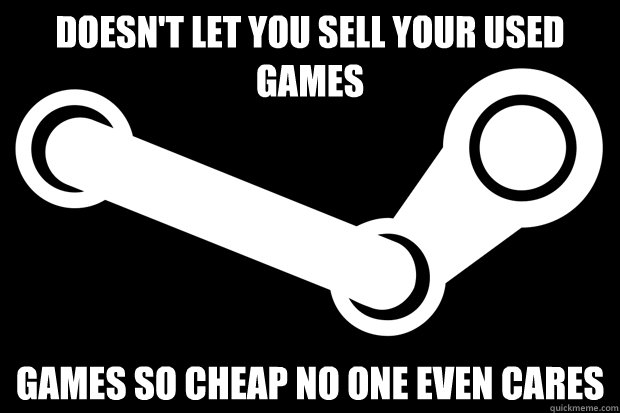
The company's opinion: There is a perfect comparison to be made here: Steam vs XBox.  Both prohibit the resale of games, but have had very different consumer responses.  Microsoft made a big deal out of it at their presentation, saying it gives more money back to the developer, and stated how it makes sense from a business point of view- leading the consumer to believe they're not cared for, it just proves Microsoft are money-grabbing again.  Steam kept the lack of resales quiet- it wasn't something that needed to be said.  Because they are entirely digital, to the consumer it feels different- it doesn't feel like they're owning an actual product because there's no disc to 'own', and they're ok with that.  On top of that, due to the lack of a physical medium and the various costs associated with manufacture (creating the discs, the labor associated with this, the logistic costs, etc), Steam can afford to charge significantly less whilst still giving proceeds directly to publishers.
The result: Steam is loved by the majority of consumers for being an incredibly cheap platform, whereas XBox is hated due to it grabbing as much money as possible without caring for the consumer.  This resulted in yet another u-turn from Microsoft, and now they're saying you are able to resell any XBox One games- however the consumer remembers how far Microsoft tried to push it and are wondering what they're going to do next.  This wound will take a long time to heal.
Extra analysis:  Pre-owned games are, arguably, a good thing for the industry.  Looking purely at the numbers, it is true that no profit goes to the publisher, which is a bad thing. However, consider this scenario: Someone wants to buy Pokemon X, but thinks it's a bit expensive so they decide to sell their GBA games, as they're now obsolete- they're not being produced, but are still playable.  They get £25, meaning they're now effectively only spending £10 on Pokemon X, yet the publisher still gets the full £35.
They don't get the money from the resale, but they don't make the games any more so there was no way they would get money from it anyway.  Assuming each of those GBA games was sold to a different person, that is now 5 people who thought they would try this 'pokemon' that everyone keeps going on about, and £5 for a game is quite reasonable.  3 of the buyers decide they loved the game and want more, so immediately buy Pokemon X or Y (the publisher has now made a total of £140, which wouldn't have been possible without pre-owned sales).  The 2 that didn't like the game also resell for £5 each, getting their money back to spend on a new game- the 2 people that bought from them love the games and also buy Pokemon X or Y.  Now the publisher has made £210 all from pre-owned sales, not including future games they release that now have 5 new customers.
I'm looking forward to these in case you couldn't tell.
Therefore my solution to the pre-owned problem? For entirely digital games such as on Steam, it costs nothing to keep the games available therefore the publisher gets money from every sale.  For entirely physical games, such as the majority of console games, the customers gained from reselling obsolete games (arguably) balances the resales of current games.  For games that are a mixture of the two, such as those proposed for XBox One, it is easy to put a restriction on reselling until the game becomes obsolete getting the best of both worlds.  Consumers wouldn't be happy, but they wouldn't be angry as they are when you take away their rights altogether.

Kinect is always watching
The facts: The XBox One has a built in camera/microphone that cannot be disabled without turning the power off.  The reason for it staying on is so it can switch the console on by the user saying 'turn on'.  It is also predicted to be used for the purposes of advertising.
The problem: The fear that the device is spying on you, the government is watching everything you do and attempting to control you.  We're entering an Orwellian dystopia.
The company's opinion: Silence.  So far no real rebuttal has been made to criticisms, presumably because Microsoft doesn't think they need to give an answer as all consumers are insane conspiracy theorists.  The official statement for their reasons for implementing the Kinect in the first place are so they can provide a tailor-made experience and improve ease of use.
The result:  Consumers are slowly rationalising this, but is that a good thing?  It is true that no-one's interested in what you're doing in your front room whilst playing video games, but the real issue comes from the advertising side of things.  One scenario I read recently was regarding 'tv achievements'- a new form of advertising to make your tv watching experience more interactive.  The example given was that of being given an achievement if you could demonstrate to your Kinect that you had bought a certain brand of crisps by displaying them to the camera, and this achievement would contribute to your gamerscore.  This terrifies me more than just the government listening for the word 'assassin' to come up in conversation (a somewhat amusing thought when you consider one of the flagship games for XBox is Assassins Creed).  But then I've probably just been watching too much Black Mirror and Wall-E...

This article has been primarily about Microsoft, but that doesn't mean Sony and Nintendo are free from criticism.  At least Microsoft have shown attempts to be innovative, they just lack the people skills to demonstrate these features as good things.  Compare to:
Sony.  Primary marketing strategy consists of saying 'we're not doing the things Microsoft are doing'.  As such the PS4 currently looks like a PS3 with slightly improved graphics, and going by their past record it is probable Sony will wait to see what's successful on other consoles before implementing new features on their own.
Nintendo.  Primary marketing strategy consists of not being involved in console wars, letting Sony and Microsoft battle it out.  All they need to do is remind people that they have the rights to Mario and Zelda.  A huge disappointment considering the potential of their tablet controller for the Wii U.

I am now painfully aware of the length of this post so shall leave it here for now, though I am sure I shall have more to say during the next fiasco...

Thursday, 20 June 2013

Monthly Update: 6/13

Greetings all!

This month is the one in which the first real progress has been made towards setting up shop, thanks to the Prince's Trust.

We went on the Explore Enterprise course, in which we were taught all the ins and outs of running a business.  It was a good experience, and has made us much more confident in our abilities and all the more certain that we can actually make this work.  The course consisted of 4 main topics: personal skills and finances, sales and marketing, business finances, and business plans.  Without going in to too much detail, we found the whole thing surprisingly simple- the majority was just common sense, the exception possibly being the various taxes involved.  The course was let down by the fact that the tutors had no idea what we were actually doing (to them a tabletop gaming shop means slot machines), and one of the tutors hadn't done a presentation in 10 years so his presentation was a little unorganised to say the least.  However we learnt a lot of valuable information that will be taking up the majority of our time over the next year or so.

So when it comes to actual progress, we're now all steam ahead on trying to move to Bristol, in the hopes of getting a 6 month tenancy then finding a shop premises that will have living space as well.  In the meantime we have a business plan to be working on, and market research to conduct- hopefully in the form of a gaming event held in Bristol where people can bring some games to play, have a coffee, and generally have a good time, which will help me gauge how much interest there is.  More details on that closer to the time, as I have to discuss things with the Prince's Trust first.

So far, our experience of the Prince's Trust has been a good one and I highly recommend it for anyone thinking of starting a business (under the age of 30).  Lots of information, and although we don't have a mentor yet we're told they're extremely useful in giving advice when needed.  And, of course, there's the loan when you get started.

Until next time,

Daniel 'Rooksburg' van Vliet.