Showing posts with label Drugs. Show all posts

Monday, 2 September 2013

A Metaphor Too Far: X-Men First Class

You can find millions of reviews online for popular movies, so it would be futile of me to write a 'Rooksburg Reviews'- those will be saved for more obscure films and games, things you're not likely to have seen already.  Instead I will be looking at some films from the viewpoint of an English teacher that can find deep symbolism in every line of Shakespeare- regardless of whether the author intended it or not.

My first choice for this is an interesting one- X-Men: First Class.  It is interesting because of this:


So there we can see that there's not just one, but three themes that people have strong opinions about, in a decent-but-not-outstanding series that's ultimately about superheroes beating up supervillains.  The main theme picked up on is the gay theme, as shown above; for the civil rights symbolism you're better off looking at the comics.  I know the LGBT community praises the series for raising awareness, but is it really helping that much?  Anyone who notices the symbolism will be called out for reading too much into the movies, as the person above Mr. Stentz did- and the writer won't always be around to correct people.  Once you know the symbolism is intentional then yes, the series does a very good job of showing the various difficulties LGBT people face- but is it raising awareness if the only people that see the symbolism are those that are aware already?  Those audience members that need to be made aware won't see any symbolism because they think they're just watching a comic-book movie about blowing things up.  Just one small addition would have been enough to trigger in people's minds that this is all symbolic, and that's to have an actually gay character say something along the lines of 'wow, your mutant problems are exactly the same as what I'm going through'- and I wouldn't be surprised if the writers wanted to include something like that, but openly gay characters are still frowned upon by producers.


Now I've got the serious part over with, time for some fun that relies on one extremely cynical viewpoint: it's easy to say symbolism is intentional if someone's done the work for you.  It makes you look like you're open-minded and performing a greater service, just because people are seeing what they want to see- after all, the gay subtext could just as easily be seen as anti-gay based on the actions of Magneto and the Hellfire club, who coincidentally are the characters most open about their 'mutations'.
To prove my point on how easy it is to find symbolism for anything, here's an interpretation of X-Men: First Class as a tale about the War on Drugs, in the height of the swinging sixties.
Please note that if you enjoy the film as it is and don't want it ruined then you may want to look away now.
(I thought this would be quite a ridiculous interpretation, but the more I looked the more I wondered if this was the actual message the writers wanted to convey- I see a lot more symbolism for drugs than I do for homosexuality... make of that what you will)

The key to understanding this interpretation, is that the severity of the mutation reflects the severity of the addiction.
First we have Shaw- powerful drug lord, and the central character to the story.  He has the most powerful mutation/habit, and is in full control of it.  His plan is to trigger World War III, which he hopes will create a world of mutants- people that have found a vice to relax their fears.  Significant to his plans is establishing a foothold in Cuba.

His first victim is Erik/Magneto.  He discovered his mutation in a Nazi laboratory, run by Shaw.  Shaw offers him a piece of candy- he refuses.  Shaw tries to convince him to try 'just a little' manifestation of his powers- he refuses.  Eventually it takes the killing of his mother to push Erik over the edge- in his grief he becomes completely addicted to his powers, but can't bring himself to kill his supplier, who says 'we're going to have a lot of fun together'.  Erik embraces his mutation, becoming completely dependant on it, and spends his life hunting down Shaw- the man that turned him into a monster.  When Erik lost control of his power- nearly dying when trying to lift the sub- Xavier helped him, and took him to his rehab centre.  Erik was going to leave rehab, but acknowledges he needs the help.  When Erik finally confronts Shaw, he can't resist just one more tiny use of his powers- enough to send him spiralling out of control, and taking Shaw's place as drug lord much to Xavier's dismay- he becomes Xavier's failure.

Xavier still suffers migraines from his addiction
Xavier/ Professor X, as previously mentioned, set up a rehab centre.  He has first-hand experience of mutations, but now has it under control.  It is implied that he started due to a poor relationship with his mother.  Because he managed to control it, he wants to help others control their powers.  His experience also means he can identify when others have a problem.  He still suffers migraines from time to time, hence raising his hand to his head.

Raven/ Mystique has the greatest dependence on her powers.  In fact she needs them to get through daily life, and she is constantly trying to mask them.  She is introduced as having broken into a rich house, looking for food, and unable to conceal her power.  Xavier takes her in, his first attempt at healing someone.  She can't control herself, especially when tired or stressed.  Erik points out it takes all her strength to hide, so she should be open about it and it will make her more relaxed- she eventually succumbs and joins Erik when he becomes Magneto.  Hank hoped he could cure her dependence, but she refused.

Hank/Beast was very good at hiding his mutation- Xavier notices, to which Hank says 'you didn't ask so I didn't tell'.  He is highly intelligent, and is working on a cure that will keep the power whilst hiding the superficial evidence.  Unfortunately it doesn't work, and Hank becomes Beast- a creature with a short temper and entirely driven by his addiction.

Darwin's overdose
Xavier's 'recruits': Angel works as a stripper in a nightclub, her ability always on show but unnoticed.  She attempts rehab but it doesn't work for her, so she falls for Shaw's temptation.  Darwin is proud of his ability and thinks he will live forever- his ability lets him 'adapt to survive'- but when Shaw comes along, he OD's on his own power.  Havok was imprisoned due to his ability- he acknowledges that he's destructive when under the influence, and very self-conscious about it, but with Xavier's help he can focus himself more.  Banshee is found as a teenager hanging out in a dark aquarium, and although he enjoys his ability it often makes him scream- usually through fear.

The Hellfire club: Azazel is so reliant on his ability that he now looks completely inhuman, and couldn't hide it even if he wanted to.  Riptide is a quiet man in a suit, and when he uses his ability it's variable as to how potent it will be.  Emma Frost looks perfectly natural, but is quite happy to demonstrate her ability in public, much to the horror of anyone watching.


So there you have it.  The film is in fact about a drug lord in the 60s trying to make the whole world reliant on him, whilst those that know how much pain drugs can cause are working with the American government to try and stop him.  They succeed, but only for a new drug lord to take his place, mostly due to all drug-users being labelled as criminals.  Personally I see that interpretation as having much more evidence than the homosexual interpretation...

...but then again

Saturday, 3 August 2013

The Many Themes of Disney: An Overanalysis


For over 75 years, Disney has been synonymous with good animation.  And for good reason.  Most people watched a Disney film so far into their childhood they don't even remember it; all they remember is that it was good.  Then as they grow older they start to notice all the political incorrectness, and over-extend metaphors for drugs, and devise drinking games with their college buddies.  Then they grow older still and become parents, realising how effective the morals are and deciding their children could learn a thing or two, and so the circle of life continues.

That being said, everyone has differing views on different films- for instance my personal favourite is Hunchback of Notre Dame despite it receiving comparatively low ratings.  I have given this some thought, and separated groups of films into several recurring themes- if my theory is correct then the most popular films should contain several of these themes, whilst the least popular may only contain one or two.  More may follow in a future update.

The Princesses.
Newest at the front, ethnics at the back.
The theme Disney wants you to believe in.  Children want to be the princesses, young adults want to criticise the 'forgotten' princesses, and adults want good role models for their children (something only recently being addressed by Disney).  For the purposes of this article, I will divide the princesses accordingly.
The 'popular' princess films: Snow White, Cinderella, Sleeping Beauty, The Little Mermaid, Beauty and the Beast, Aladdin, Tangled, and Princess and the Frog.
 Odds are children will want to imitate the heroine from at least one of these films, and if they do then the theory is that they will enjoy the others in this group.  Note that they have been getting progressively 'stronger' as society has progressed to have better female role models.
The latest 'Disney Princess'
The 'other' princess films: Pocahontas, Mulan, Brave, The Black Cauldron, Wreck-it-Ralph, and Princess and the Frog.  These are the princesses that some claim Disney have 'pushed aside' due to being unmarketable, whether due to ethnicity or age.  Note the inclusion of Princess and the Frog, as some consider the film to be too recent for Tiana to be forgotten, but her time is coming due to her ethnicity.  These films are most enjoyed by those that enjoy pointing out Disney's political incorrectness.  Incidentally these are also the strongest female role models.
The 'hipster' princess films: Bambi, Peter Pan, Robin Hood, Hercules, Atlantis, and Enchanted.  This category is so named as it is most enjoyed by those that have a smug self-satisfaction when explaining to others how the female leads are 'technically' Disney princesses whilst not being officially considered as such.  These viewers are most likely to call Princess Leia their favourite princess, as she's 'technically' a Disney princess now.

Snakes.
Prominent examples: Aladdin, Robin Hood, Sword and the Stone, Princess and the Frog (special mention to the Little Mermaid, which used snake-like fish).
Just ignore the fact he sounds like Winnie the Pooh.
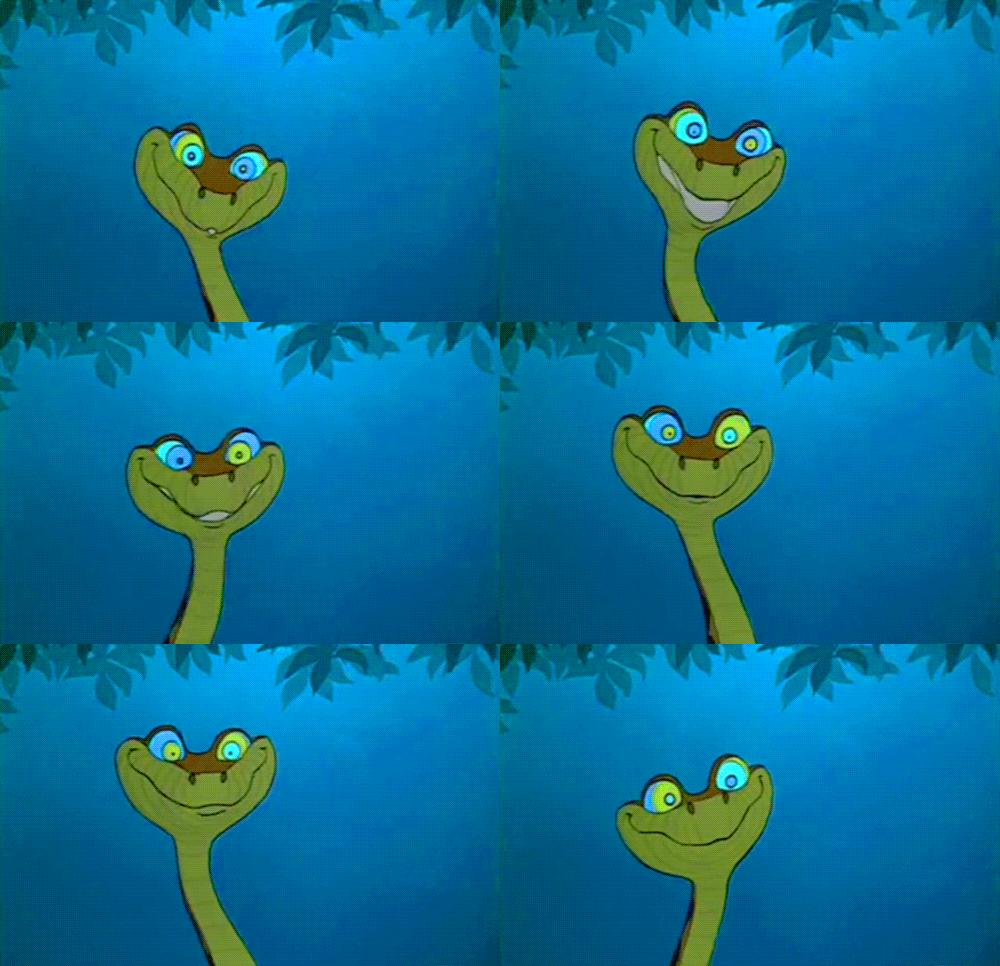
Snake imagery is used a lot in Disney, occasionally in a hypnotic form (see: Kaa, and Jafar's staff).  Interestingly they are always shown as cowardly- a somewhat unusual characterisation that I don't believe I have seen outside of Disney.  More typically, they are also shown as highly untrustworthy.  They are always a supporting villain (except in Princess and the Frog, which subverted many clichés), to the extent that the majority of appearances happen in the various tv spin-offs.  If you enjoy this Disney-specific archetype, your favourite film is likely to be the Jungle Book.

Cats.
Most commonly occurring in contemporary films, cats are often inherently evil or at the very least mischievous- rarely are they shown in a positive light.
Never trust a grinning cat.
'Evil' cats: Sword and the Stone, Cinderella, Basil the Great Mouse Detective, Emperors New Groove, Pinocchio.  The cats are most commonly manipulative, greedy, or outright evil.  Not unique to Disney, as many consider real-life cats to be inherently evil and vindictive.  If you enjoy evil cats, your favourite film is probably Lady and the Tramp- two evil cats for the price of one, and as you're probably a dog person you get the bonus of the protagonists being dogs.
'Big' cats: Jungle Book, Tarzan, Aladdin.  Interestingly, big cats are wise and friendly- with the exception of Sabor from Tarzan who is a mindless killer.  Naturally, if you enjoy films with big cats then your favourite film is the Lion King.
'Mischievous' cats: Aristocats, Pinocchio, Oliver and Company.  Often these cats are kittens that are yet to learn they're supposed to be evil, however your favourite is probably going to be the Cheshire cat from Alice in Wonderland.

Alcohol/ Drug references.
Almost every film involves alcohol or other drugs- seriously, keep an eye out next time you watch one.  It may be for brief moments, such as glasses of wine in Aladdin, or the feast of fools in Hunchback, but at other times it's more noticeable- join me as I play 'Drink along with Disney'.
Robin Hood- Sir Hiss gets drunk after being trapped in a barrel of (strangely coloured) ale.
Beauty and the Beast- Copious amounts of drinking with Gaston in the tavern.
Basil The Great Mouse Detective- A drunk mouse finds himself in trouble
Pinocchio- Alcohol and tobacco contribute to Pinocchio 'making an ass of himself'.
Nightmare fuel.
And, of course, the pinnacle is Dumbo- full on Disney Acid Sequence from Dumbo indulging in too much champagne.  This crosses over into the next subcategory: the Disney Acid Sequence, things that must have been conceived whilst under the influence.
The Lion King- 'I Just Can't Wait to be King'.
Winnie the Pooh- Various.
Aladdin- 'Friend Like Me'.
If you like any of the above over any other Disney feature, then odds are your favourite film is either Alice in Wonderland or Fantasia- both are feature-length acid trips, Fantasia getting the edge as it even involves Dionysus the God of Wine.

Fire.
Fire is the one element that appears in every Disney film, and seems more prominent in the more popular films.  This is probably the theme that attracts me most, and through sheer coincidence the more fire there is, the more I like it.  Here's a run-down of my top 10 Disney films, and the amount of fire involved. (Special mention to Toy Story 3 for the furnace, as I wasn't going to include Pixar).
Hercules- Hades' 'angry' face.
Dumbo- The circus act.
Sword and the Stone- the Wizard's Duel.
Fantasia- A glimpse of the pits of Hell as shown in Night on Bald Mountain.
Robin Hood- Prince John's castle is set alight.
Aladdin- Climactic battle in a ring of fire.
The Lion King- Lightning sets fire to the desolated pride lands.
Jungle Book- Lightning sets the scene for a climactic battle in a ring of fire.
Hunchback of Notre Dame- the whole city of Paris is set alight, and there's a song dedicated to Hellfire.
Treasure Planet- an entire planet goes up in flames.

OK, I take back what I said at the start- Treasure Planet is my favourite Disney film.